
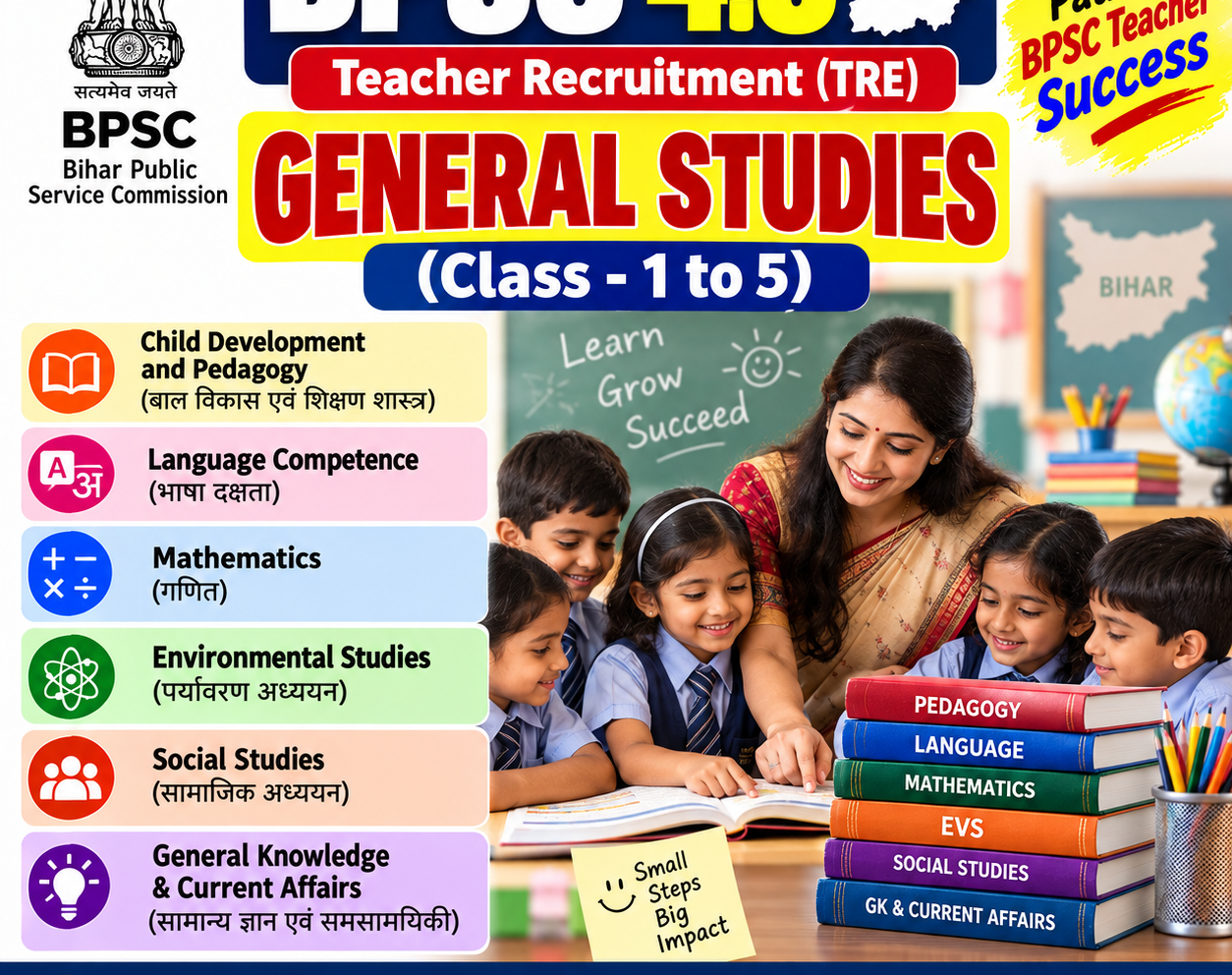
BPSC TRE 4.0 General Studies (Class-1 to 5)

- 1 Section
- 1 Lesson
video
General Studies Syllabus
Elementary Mathematics
• Number system: natural numbers, whole numbers, integers, rational numbers, fractions, decimals, place value, divisibility
rules, factors and multiples, HCF and LCM.
• Simplification and approximation: BODMAS, fractions/decimals, squares, cubes, square roots and estimation.
• Ratio and proportion: equivalent ratios, direct proportion, inverse proportion, unitary method and applications.
• Percentage: conversion between fractions/decimals/percentages, percentage increase/decrease, successive changes and
applications.
• Profit, loss and discount: cost price, selling price, marked price, discount, profit/loss percentage and successive discounts.
• Interest: simple interest, compound interest, amount, principal, rate, time and basic applications.
• Average: arithmetic mean, weighted/basic averages and age-based applications.
• Time and work: work efficiency, combined work, wages, pipes and cisterns.
• Time, speed and distance: basic speed, average speed, relative speed, trains, boats and streams.
• Algebra: algebraic expressions, identities, linear equations, simple simultaneous equations, powers and exponents.
• Geometry: lines, angles, triangles, congruence, similarity, quadrilaterals, polygons, circles and basic constructions.
• Mensuration: perimeter, area, surface area and volume of common 2D/3D figures.
• Data handling: tables, pictographs, bar graphs, line graphs, pie charts, mean, median, mode and basic probability.
Mental Ability Test
• Analogy: word, number, alphabet and figure analogies.
• Classification: odd-one-out based on words, numbers, letters and figures.
• Series: number, alphabet, mixed and pattern series; missing-term questions.
• Coding-decoding: letter coding, number coding, substitution and pattern coding.
• Blood relations: family trees, coded relations and generation-based questions.
• Direction sense: compass directions, turns, distance and route tracing.
• Ranking and ordering: position, age, height, marks and comparison problems.
• Syllogism: statements, conclusions, logical deduction and basic Venn-diagram representation.
• Venn diagrams, calendars, clocks, missing numbers, simple puzzles and non-verbal reasoning.
General Awareness
• India and neighbouring countries: geography, history, capitals, currencies, important institutions and major
bilateral/regional developments.
• Current affairs: national and international events, government schemes, appointments, awards, books and authors,
reports, summits, important days and recent developments.
• Indian history and culture: ancient, medieval and modern periods; art, literature, heritage, festivals and important
personalities.
• Indian polity: Constitution, Preamble, Fundamental Rights, Fundamental Duties, Directive Principles, Parliament,
President, Prime Minister, judiciary, elections, federalism and local government.
• Indian economy: basic concepts, sectors, banking, inflation, taxation, budget, development indicators, poverty,
unemployment and major welfare schemes.
• Sports: major tournaments, trophies, players, records and sports-related current affairs.
• Environment and ecology: biodiversity, conservation, pollution, climate change, sustainable development and
environmental institutions.
General Science
• Physics: measurement, units, motion, force, work, energy, power, gravitation, pressure, heat, temperature, sound, light,
reflection, refraction, electricity and magnetism.
• Chemistry: matter, physical/chemical changes, atoms, molecules, atomic structure, elements, compounds, mixtures,
periodic classification, chemical reactions, acids, bases, salts, metals, non-metals and carbon compounds.
• Biology: cell, tissues, plants, animals, nutrition, respiration, transportation, reproduction, heredity basics, microorganisms,
human body systems, health, diseases and immunity.
BPSC TRE-4.0 2026 | Detailed topic-wise syllabus Page 3
• Environment: ecosystem, food chain, food web, natural resources, pollution, conservation, biodiversity and climate
change.
Social Science
• History: ancient India, medieval India, colonial India, major dynasties, social and cultural developments and the freedom
movement.
• Civics: democracy, institutions, elections, rights, Constitution, federalism, local government and citizen participation.
• Economics: sectors of the economy, poverty, unemployment, money and credit, development, public facilities, markets
and sustainable development.
• Social issues: diversity, inequality, gender, education, health, livelihoods, population and social change.
Geography and Environment
• Solar system: Sun, planets, satellites, Earth and basic astronomical concepts.
• Earth: shape, motions, latitudes, longitudes, time zones, maps, scale and directions.
• Physical geography: continents, mountains, plateaus, plains, deserts, rivers, lakes, oceans, volcanoes and earthquakes.
• Indian geography: physiographic divisions, Himalayas, plains, plateau, coastal areas, islands, rivers, climate, soils,
vegetation and natural resources.
• Human geography: population, settlements, migration, occupations, transport, communication and human activities.
• Environment: ecosystems, natural resources, pollution, waste management, conservation, biodiversity, climate change
and disaster awareness.
Indian National Movement
• British expansion and consolidation in India; major administrative and economic changes.
• Revolt of 1857: causes, major centres, leaders, nature and consequences.
• Socio-religious reform movements, modern education, press and growth of political awareness.
• Rise of Indian nationalism and formation of the Indian National Congress.
• Partition of Bengal, Swadeshi and Boycott, revolutionary activities and Home Rule movement.
• Gandhian era: Champaran, Kheda, Ahmedabad, Non-Cooperation, Civil Disobedience and Quit India movements.
• Role of major leaders, women, peasants, workers and tribal communities in the freedom struggle.
• Constitutional developments, Cabinet Mission, transfer of power and independence.
Want to submit a review? Login